The AI Hierarchy of Needs
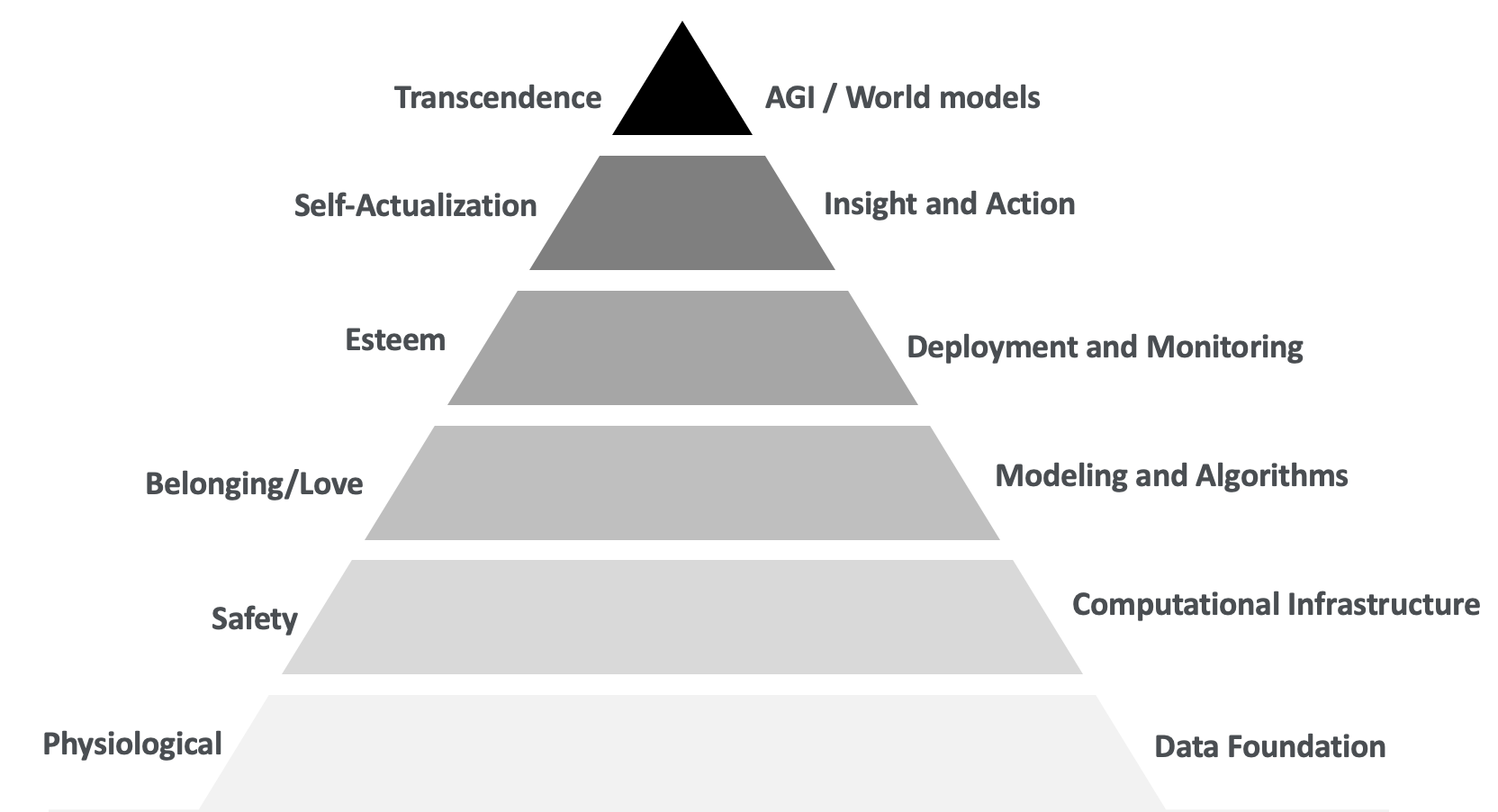
A Framework for Understanding and Building Effective AI.
In his seminal 1943 paper, psychologist Abraham Maslow proposed his theory of the Hierarchy of Needs. This pyramid model outlined the fundamental requirements for human growth and self-actualization. The most urgent needs—physiological and safety—occupy the base of the pyramid, while higher-order needs like belonging, esteem, and self-actualization form the upper levels. Progress is only possible when the lower-level needs are sufficiently met.
Inspired by this concept, data scientist and AI thought leader Monica Rogati outlined a similar hierarchical framework for data science and artificial intelligence in 2017. Borrowing from both Maslow’s foundational model and Rogati’s insights, we can develop an “AI Hierarchy of Needs” to guide the development and implementation of successful AI systems.

-
Data Foundation (Physiological): At the base of our AI pyramid lies the vital need for data. Without consistent and reliable data sources, AI models cannot learn or make inferences.
- Data Collection: Establishing processes and infrastructure to gather data from relevant sources (sensors, customer interactions, web scraping, etc.).
- Data Storage: Ensuring secure, scalable, and organized mechanisms for storing the collected data.
- Data Quality: Implement data cleaning, transformation, and validation practices that ensure accuracy and reduce bias.
-
Computational Infrastructure (Safety): AI models require significant computational resources for training and operation.
- Hardware: Selecting appropriate hardware (CPUs, GPUs, TPUs) based on the complexity of models and data size.
- Software: Utilizing efficient and scalable AI frameworks and libraries (TensorFlow, PyTorch, etc.)
- Networking: Ensuring robust network connectivity for data transfer and, in some cases, distributed AI systems.
-
Modeling and Algorithms (Belonging/Love): This layer is where the core AI model selection and development reside.
- Algorithm Selection: Choosing algorithms aligned with your problem – classification, regression, clustering, natural language processing, etc.
- Model Development: Iterating on the design and training of the AI model to improve its accuracy and performance.
- Hyperparameter Tuning: Optimizing settings within the model that impact its learning process.
-
Deployment and Monitoring (Esteem): Here, the AI model transitions from laboratory to real-world scenarios, and ongoing observation is key:
- Integration: Seamlessly incorporating the model into existing systems or applications where it will generate insights or actions.
- Performance Monitoring: Tracking key metrics and establishing alerts to detect model degradation or unexpected behavior.
- Continuous Improvement: Retraining models with updated data or fine-tuning to adapt to changing conditions.
-
Insight and Action (Self-Actualization): The current pinnacle of the pyramid is where AI transcends prediction and delivers real value.
- Explainability and Trust: Providing clear explanations for AI outputs to foster trust and responsible decision-making.
- Decision Support: The AI system offers insights that drive informed choices in business strategy, operations, or research.
- Automation: Where appropriate, AI takes certain tasks out of human hands, leading to efficiency gains and freeing up time and resources.
-
AGI / World models (Transcendence): …

Just Like Maslow’s…
As in Maslow’s model, lower levels of the AI Hierarchy must be sufficiently addressed before progressing to higher levels. A stunningly accurate model won’t achieve self-actualization if the data it’s fed is poor, or if it crashes due to inadequate hardware.